Author: Miranda

  • Bunion aka “Hallux Valgus”

    I suppose we should start with, what is a bunion?  A bunion is a common deformity found usually within the first joint of the big toe.  It is a slow dislocation or movement of the big toe towards the middle of your foot.  In some cases it can occur on your pinky toe as well, in that case it is called a Tailor’s bunion or bunionette. 

    Bunions tend to develop in stages.  The first is the inflammation stage.  Here it can present as a red bump or swollen area below your big toe and can be painful within the joint.  At this point the joint still has movement and is considered a mild form of a bunion.  In the next stage the toe becomes more curved and the movement in the toe decreases.  This occurs as it becomes more of a chronic condition and is no longer considered new. As the toe continues to deviate it can result in things like hammer toes, and reduce our ability to balance. Along with the decreased movement of the toe we may develop new foot pain in our arches, legs or back. Once a bunion is established they are usually pain free.  Any pain felt in the area is usually a result of another condition. 

    Some causes of these deformities can be improper footwear, hereditary, past trauma to the foot, or if we were required to stand in one spot for long periods of time for work. 

    A couple things that you can do to aid in reducing the pain and severity of your bunion are, proper foot wear, routine visits with your Dr., Podiatrits or foot care nurse to monitor and help guide care for it. There are some exercises you can do as well to help keep the flexibility in the great toe. Inserts for between the toes and some bunion pads can be helpful as well. In extreme cases of bunions there can be an option of surgery to correct it. 

  • Nail Fungus!

    Oh Boy, where do I even start? Nail fungus, that fungus that keeps on giving. So many people struggle with this, in fact 10-20% off the populations does and 50-60% of that is amongst seniors over aged 60. The number one thing that I hear from people is how they have been trying for SO long to get rig of it but NOTHING is working!  When I hear that I ask “are you persistent with your treatment?” and most will say “no”.  This is so key in treating nail fungus.  If you aren’t persistent with what you are doing it will be more persistent and remain with you. 

    That being said you may be wondering how do I treat it and have success or even do you need to treat it at all? Well, depending on your age and how bad the infection is, is where you would start to determine how aggressive you want to be with treating it and if you even want to.  

    There are several types of treatments for nail fungus. The first is mechanical.  This is removing the infected part of the nail.  Myself or another foot care nurse can do this part for you.  After this occurs the nail will tend to look worse but it will allow any topical treatments to actually penetrate the layers of the nail. The next is topical treatments or creams you can apply.  These have to be done routinely and as directed.  They won’t be effective if you only apply it when you remember. Another form of treatment is oral anti-virals and antibiotics.  These attack it systemically and can be difficult on other systems of the body like the liver.  Routine lab work is required while using these. Anti-virals have a 46% success rate at resolving the fungus. Later and light therapy the last options.  With these you need to ensure that it is completed by a trained professional so that further damage isn’t done to the nail or nail bed. 

    At the end of the day it is worth having a discussion with your family Dr., Podiatrist, or Foot Care Nurse to discuss what is going to be best for you.  It is key to look at other health issues when thinking about your treatment and to find out what caused it so it does’t happen again. In the end know that you aren’t alone and there is treatment available for you. 

  • Deformities of the toes

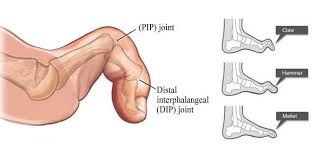
    One of the more common issues I see clients for is corns or pain on the tips of the toes while walking. There are several types of toe deformities that can cause this and a few of the more common ones are: Hammer Toes, Claw Toes, and Mallet Toes. 

    Hammer toe: a toe that is permanently flexed downward due to a contraction of the proximal interphalangeal joint  (PIP) (Core Curriculum Wound Management, 2016). The joint is difficult to straighten if it is able to at all.  It tends to result in corns developing on the top of the toe.  They can be hereditary or caused as a result of bunions. 

    Claw Toe: caused by flexion contractures involving the PIP joint and distal interphalangeal (DIP) joints (Core Curriculum Wound Management, 2016).  This results in a “claw shaped” toe giving it its name.These tend to result in corns on the tips and tops of the toe. 

    Mallet Toe: flexed deformity due to the contracture of the DIP joint.  It tends to result in corns on the tip of the toe (Core Curriculum Wound Management, 2016).

    Claw toes and Mallet toes are often seen in those with diseases related to motor neuron neuropathy and muscle imbalance like diabetes (S. Tremble B.Sc.N, 2015.  Nursing Foot Care (p44).) 

    One cause that all of these have in common is improper fitting foot wear.  This can be shoes that are too large so the toes are constantly “gripping” or too small so the toes are being squished together. Proper fitting shoes are very important in the prevention of many different deformations and causes of pain in the foot. 

    What can you do to help reduce the discomfort of these? You guessed it, proper fitting foot wear!  There are also supports for your toes to release pressure on the tips with walking or wearing footwear. Routine visits with your Dr., podiatrist, and foot care nurse to monitor and advise as well as provide any care for things like corns or calluses that can result in pain, issues with mobility and potential wounds.  In some more extreme cases surgery can be performed. 

  • Plantar Faciitis

    I get many calls and messages from clients enquiring about Plantar Faciitis and how I am able to assist them.  Although I may not be able to directly resolve the issue, I am able to provide some direction and tips on how to manage it.  So, let’s start with what is it?

    Plantar Faciitis is one of the most common causes of heel and arch pain within the foot. It is caused by an inflammation of the plantar fascia and/or Achilles tendon, oftentimes due to poor foot mechanics (American College of Physicians, 2012).  This can be a twisting motion of the foot and facia within it. It can occur when we do a new sport we aren’t used to doing like running for the first time. Another cause can be wearing improper foot wear while doing different activities that may require more or less support.  Plantar fasciitis can also be common in those with flat feet or high arches (S. Tremble B.Sc.N, 2015. Nursing Foot Care (p54-55)).

    Now the question is what can you do to assist with the discomfort of it and potentially resolve the inflammation and pain? For starters, always ensuring that you are wearing appropriate foot wear for your feet and the activity you are doing. Wear shoes or slippers when inside instead of going bear foot will help support the arch and facia within the foot. During the night you can sleep with your feet against a board to keep the facia stretched through the night.  Prior to rising in the morning flex your feet with the knees bent and legs straight (S. Tremble B.Sc.N, 2015. Nursing Foot Care (p55)).  You can also try rolling your foot over a water bottle or can.  Icing the heel for 15 min intervals several times over the day or after activity. Seeing a physiotherapist to acquire excersices to strengthen the foot is recommended as well as seeing your Dr. or podiatrist if pain isn’t improving.  In some rare situations surgery may be required. 

    Prevention and acting quickly when pain starts is key in a quick recovery!